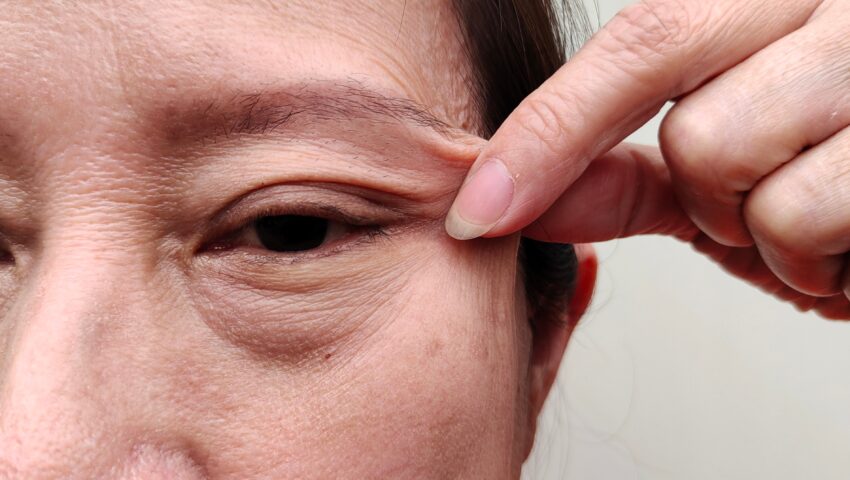
You’ve read the articles. You know the story by heart: collagen declines in your mid-twenties, elastin loses its snap, and gravity does the rest. You’ve invested in the serums, the retinols, the devices that promise to firm and tighten. And yet — something in the mirror still doesn’t add up. The skin itself looks fine. But the face looks different. Heavier, somehow. Less defined. Like a drawing that’s been slightly smudged.
Here’s what most skincare content won’t tell you: what you’re seeing may have very little to do with your skin.
The Story We’ve All Been Told
Collagen loss is real. So is the gradual thinning of the dermis, the breakdown of elastin fibers, and the slowdown of cellular turnover. These are documented, well-understood processes, and the skincare industry has built a $200 billion empire on addressing them.
But the face isn’t just skin. It’s a layered system — skin sitting over fat, fat sitting over fascia, fascia wrapped around muscle, muscle attached to bone. When the face changes with age, it changes at every one of these levels simultaneously. Treating only the outermost layer while ignoring the rest is a bit like repainting the exterior of a house that has a structural problem. It can look better temporarily. But it doesn’t hold.
What’s Actually Happening Beneath the Surface
Muscles that have stopped working
The face has over 40 muscles, and like muscles anywhere in the body, they respond to use, tension, and neglect. Some facial muscles become chronically tight — from stress, jaw clenching, screen time, and repetitive expression. Others quietly atrophy from underuse.
When facial muscles weaken, they can no longer provide the upward support the overlying tissue depends on. The result isn’t skin loosening — it’s architecture failing. The cheeks descend not because the skin gave out, but because the muscular scaffold beneath them stopped holding its position. As our post on the science behind facial massage explains, massage can directly stimulate the fibroblast activity that supports muscle and connective tissue health at a cellular level.
Fascia that has tightened and thickened
Fascia is the connective tissue that envelops and connects every structure in the body, including the face. In a young, healthy face, it’s supple and elastic. Over time — accelerated by inflammation, dehydration, chronic stress, and repetitive tension — it tightens, thickens, and forms adhesions that pull facial features downward and inward.
Fascia in the face exists within a structure surgeons call the SMAS — the superficial musculoaponeurotic system, the same anatomical layer that surgical facelifts target. Research published in Skin Research and Technology used CT imaging to confirm that facial massage produces measurable changes in the SMAS and surrounding tissue, shifting the cheeks upward and improving structural positioning.
You can’t moisturize your fascia. You can’t stimulate it with a serum. This layer responds to manual pressure and specific therapeutic techniques designed to release it from the inside.
Lymphatic congestion adding weight to the face
The lymphatic system has no pump of its own — it relies entirely on movement and manual stimulation to circulate. When lymph flow slows, fluid accumulates in facial tissue, creating a heaviness and puffiness that reads as sagging even when the underlying structure is intact.
This is especially common in people who sleep on their side or stomach, sit at a desk for long hours, or carry chronic tension in the neck and shoulders. You can read more about how lymphatic stagnation shows up in the face in our post on understanding facial swelling: myths, causes, and solutions. The congestion isn’t a skin problem. It’s a circulation problem — and it’s one that responds well to targeted manual work.
The neck and posture connection
This one surprises people most. Forward head posture — which has become almost universal in the age of phones and laptops — doesn’t just affect the neck. It creates a chain of compensations that travel directly into the face, altering how the lower face and jawline are supported and how fluid drains from the facial tissue.
The neck is the scaffolding of the face. If it’s compressed and tight, the face reflects it. In many cases, addressing tension in the neck and jaw area becomes just as important as working on the face itself.
Why This Distinction Changes Everything
When sagging is a structural problem — one rooted in muscle tone, fascial restriction, lymphatic congestion, and postural tension — it requires a structural solution.
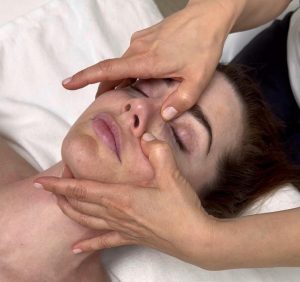
This is precisely what face sculpting massage addresses, and why it produces results that topical products cannot. A treatment like Reconstructive Facelift Massage (RFL) works at the level of muscle, fascia, and lymphatic tissue — releasing adhesions, retraining muscular support, restoring circulation, and addressing the deeper mechanics that determine how a face holds itself together.
It doesn’t add anything to the face. It restores what was already there.
If you’ve been curious about how professional facial massage differs from the tools and techniques you’ve seen on social media, our post on gua sha vs. professional facial massage is a good place to start.
A Different Way to Look at It
Think of it this way: when an athlete loses strength or mobility, no one hands them a cream and sends them home. They work with the tissue — actively, manually, structurally. The face deserves the same logic.
Sagging isn’t a sentence. But it does require understanding what’s actually driving it before you can genuinely address it. If the products aren’t giving you the results you expected, it may be because the problem was never at the surface to begin with.
At Via Skincare in Studio City, Los Angeles, Reconstructive Facelift Massage is designed to address the root causes of facial aging — working at the level of muscle, fascia, lymphatic drainage, and postural alignment. Book a consultation to understand what your face actually needs.