
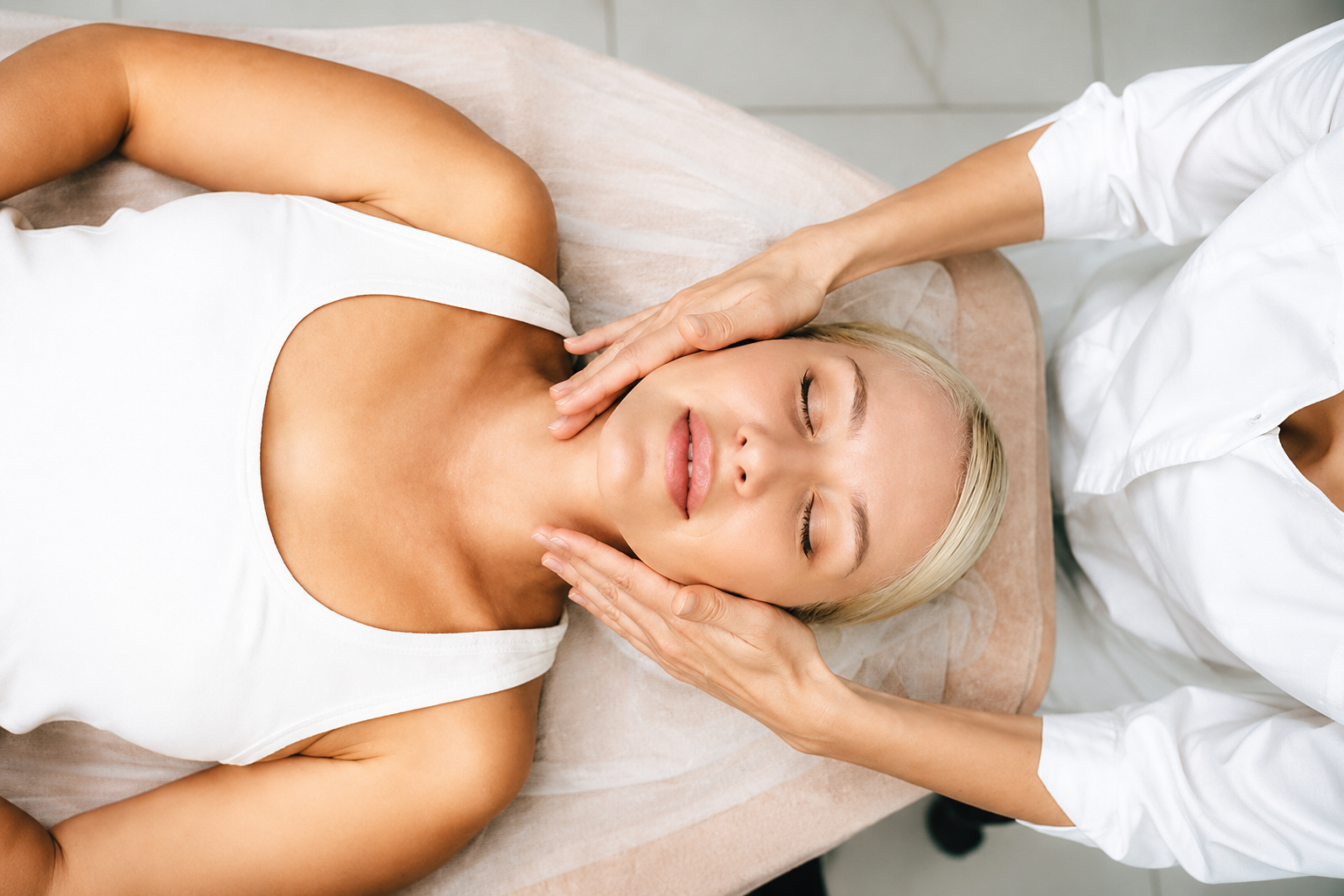
You’ve probably seen it mentioned alongside glowing skin, post-surgery recovery, and depuffing routines. You may have even tried a jade roller or gua sha tool because someone online said it “moves your lymph.” But if you’ve never had a professional facial lymphatic drainage massage, there’s a good chance you don’t fully know what it actually does — or why the difference between a tool and a trained therapist matters enormously.
This post explains the real anatomy behind facial lymphatic drainage: where your facial lymph nodes are, what happens when fluid stagnates in your face, and what a properly administered session — using the Dr. Vodder method — actually involves. Not the social media version. The clinical one.
What Facial Lymphatic Drainage Massage May Do
- Clear excess interstitial fluid from facial tissue
- Reduce puffiness in the cheeks, jawline, and lower face
- Support skin radiance and circulation
- Activate the parasympathetic nervous system
- Prepare tissue before surgery or support recovery after
- Address skin conditions linked to lymphatic congestion such as rosacea and acne
What Facial Lymphatic Drainage Massage Can Help With
If any of the following sounds familiar, your lymphatic system is likely part of the conversation:
You wake up with a puffy face. Morning facial puffiness — across the cheeks, jawline, or lower face — is one of the most common signs of overnight lymphatic stagnation. Fluid accumulates when the system slows during sleep and has nowhere to drain efficiently.
Your face feels heavy or tired even when you’re not. That weighted, slightly blurred quality to the lower face — where the jaw loses its edge and the cheeks feel thick — is often interstitial fluid sitting in tissue that isn’t draining.
Your skin looks dull no matter what you put on it. Congested lymphatic tissue impairs nutrient delivery to the dermis and slows the clearance of metabolic waste. The result shows up as flat, uneven skin tone that skincare products can’t fully address because the issue is below the surface.
Your face swells after flying, after a salty meal, or before your period. These are all situations in which the body’s fluid balance shifts and the face — with its limited muscle activity to drive lymphatic flow — is often the first place congestion becomes visible.
You’re recovering from a facial procedure and swelling is lingering. Whether after surgery, injectables, or a skin treatment, the lymphatic system is responsible for clearing the inflammatory fluid that accumulates. When it’s overwhelmed or sluggish, swelling stays longer than it should.
You deal with rosacea, facial acne, or persistent redness. Chronic lymphatic congestion in the face contributes to the inflammatory environment that makes these conditions worse. Addressing lymphatic flow is often a missing piece in conventional treatment approaches.
You had a facelift, rhinoplasty, or blepharoplasty and want to support your recovery. Post-surgical facial puffiness is not just cosmetic inconvenience — it reflects the lymphatic system working to clear surgical trauma. Professional MLD may significantly reduce visible swelling and support a faster, more comfortable recovery.
If you recognized yourself in more than one of these, read on — the anatomy below explains exactly why these things happen and what a properly administered session actually does about them.
What Is the Lymphatic System — And Why Does Your Face Have One?
Most people know the lymphatic system exists somewhere in the body. Far fewer know that the face has its own dense, highly specific lymphatic network — and that when it stops draining properly, the effects show up directly on the surface of your skin.
The lymphatic system is a one-way drainage network that runs parallel to the circulatory system throughout the entire body. Its job is to collect excess fluid, proteins, metabolic waste, and immune cells from the spaces between cells — called the interstitial space — and transport them through lymph vessels toward lymph nodes, where waste is filtered, and eventually back into the bloodstream.
Unlike the cardiovascular system, the lymphatic system has no pump. It relies entirely on external forces to move fluid: muscle contraction, breathing, movement, and — in the face specifically — the very light, rhythmic pressure of skilled manual drainage.
When lymphatic flow in the face slows down, fluid accumulates in the interstitial space. The face retains more fluid than it should. Tissue becomes congested, sluggish, and visibly puffy. Skin looks dull rather than luminous. The features feel heavy. This is not a permanent condition — but it does not resolve on its own without either movement of the right muscles (which the face has very few of, compared to the limbs) or direct manual stimulation of the lymphatic pathways.
Where Are the Facial Lymph Nodes — And What Do They Do?
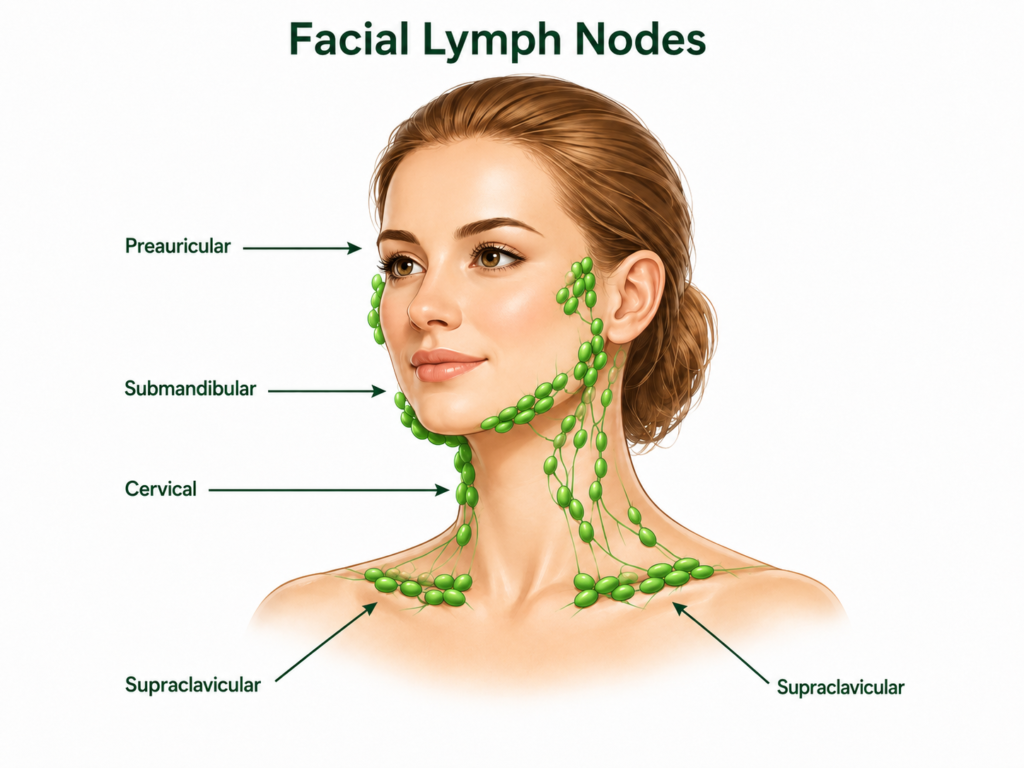
Understanding where the lymph nodes of the face are located is the foundation for understanding why lymphatic drainage must follow a specific sequence to be effective.
The facial lymphatic network drains in a predictable, hierarchical pattern. Fluid from the surface of the face moves through increasingly larger lymph vessels toward regional lymph node groups, and from there toward the terminus — the point at the base of the neck where all lymphatic fluid re-enters the bloodstream.
The primary lymph node groups involved in facial drainage include:
Parotid nodes — located near the parotid gland in front of and below the ear. They receive lymph from the forehead, temporal region, upper cheek, and outer eyelids.
Submandibular nodes — located beneath the jawline, on either side of the chin. They drain the lower cheeks, lips, chin, and the floor of the mouth, and are among the most clinically relevant nodes for facial congestion.
Submental nodes — located directly under the chin. They receive lymph from the tip of the tongue, the lower lip, and the central chin region.
Superficial cervical nodes — located along the sternocleidomastoid muscle on either side of the neck. They receive drainage flowing downward from the face and scalp.
Deep cervical nodes — the final regional filter before fluid reaches the terminus. Everything draining from the face passes through here before re-entering circulation.
This anatomy is why effective facial manual lymphatic drainage does not start at the face. It starts at the terminus — the base of the neck — to open the receiving end of the system first. Then it works proximally toward the face, clearing each node group in sequence so that fluid moved from the surface has a clear pathway to drain. Starting at the face without opening the receiving nodes is like trying to pour water through a blocked drain.
What Facial Lymphatic Congestion Actually Looks and Feels Like
Lymphatic congestion in the face does not always look like dramatic swelling. For most people, it presents as a collection of subtler signs that are easy to attribute to other causes — aging, diet, poor sleep, stress — when the underlying issue is fluid that has nowhere efficient to go.
Common signs of facial lymphatic congestion include:
Persistent morning puffiness that takes hours to resolve, particularly across the cheeks, under the eyes, and along the jawline. The face is most congested in the morning because lymphatic flow slows significantly during sleep and inactivity.
A heavy or tired appearance even when you are well-rested. This is often fluid sitting in the lower face and submandibular region, adding weight and blurring the definition of the jaw and cheekbones.
Dull, uneven skin tone that does not respond to skincare products. When the interstitial space is congested, nutrient delivery to the dermis is impaired and metabolic waste accumulates — both of which affect how the skin looks at the surface.
Recurring skin conditions such as rosacea and facial acne, which are frequently linked to chronic lymphatic sluggishness and inflammatory fluid that the system is not clearing efficiently.
Facial heaviness after flying, after alcohol, or before menstruation — all situations in which fluid dynamics in the body shift and the face is often the first place congestion becomes visible.
Prolonged swelling after cosmetic procedures — injectables, surgery, or skin treatments — that seems to resolve more slowly than expected. This is the lymphatic system under load, struggling to clear the inflammatory byproduct of the procedure.
None of these signs mean something is medically wrong. They mean the lymphatic system in the face is not draining efficiently — and that it can be helped.
How Facial Lymphatic Drainage Massage Works — The Vodder Method Explained
Not all lymphatic drainage is the same. This is one of the most important things to understand before booking any session in Los Angeles or elsewhere.
The term “lymphatic massage” is used loosely in the wellness industry to describe everything from a relaxing facial with light strokes to a clinically structured protocol developed through decades of research. The difference matters — not aesthetically, but anatomically. The lymphatic vessels of the face are extremely superficial — they sit just beneath the skin, in the dermis and hypodermis — and they respond to very specific parameters of pressure, rhythm, and direction. Too much pressure collapses the vessels rather than activating them.
Dr. Vodder method is the original and most rigorously validated manual lymphatic drainage protocol in clinical practice. Developed by Dr. Emil Vodder in the 1930s and refined through decades of research, it uses a precise combination of four foundational hand movements — stationary circles, pump technique, rotary technique, and scoop technique — applied with extremely light pressure (approximately 30–40 mmHg, roughly the weight of a coin on skin), at a specific rhythm calibrated to the natural contraction rate of the lymphangions, the smooth muscle segments of lymph vessel walls.
Why does certified training matter?
Because the Vodder method is a clinical technique, not a massage style. The sequence, pressure, rhythm, and node activation pattern are not interchangeable. A therapist without proper certification in this method — specifically certification through an accredited Vodder training program — is not performing MLD in the clinical sense, regardless of what the service is called. In Los Angeles, where “lymphatic facial” has become a marketing term applied broadly, the question of methodology and certification is the most important question a client can ask.
At Via Skincare, facial MLD sessions are performed using the Dr. Vodder method by a Dr. Vodder certified specialist — one of the very few in Los Angeles operating at this level of training.
What Happens During a Facial Lymphatic Drainage Session in Los Angeles
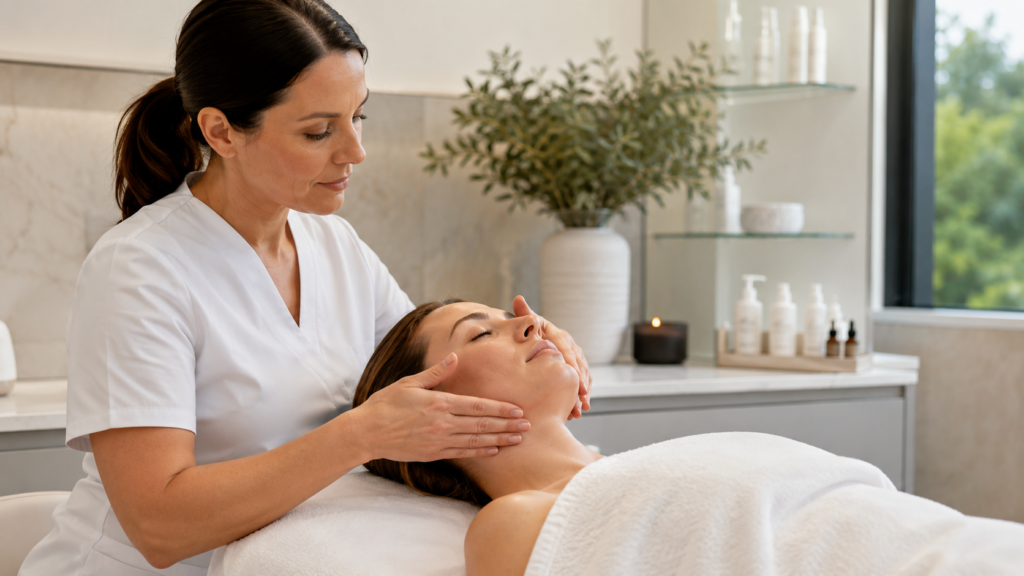
A professional facial MLD session is unlike any other facial treatment. There are no products, no steam, no extractions. The work is entirely manual — precise, focused, and structured around the anatomical drainage map of the face.
A session typically follows this sequence:
Terminus activation — The session begins at the base of the neck, not the face. The subclavian lymph nodes and the terminus are cleared first, creating drainage capacity before any fluid is moved from above.
Cervical clearance — The deep and superficial cervical lymph node chains along the neck are activated next, working upward toward the jaw. The sternocleidomastoid region receives focused attention because it is the primary channel through which all facial lymph descends.
Submandibular and submental work — The nodes beneath the jaw and chin are addressed before moving onto the face itself. This is a key step that many non-certified practitioners skip, which is why their results are limited.
Facial drainage — Working outward from the center of the face toward the ear and downward toward the jaw, the therapist uses Vodder-method strokes to move fluid from the forehead, temples, cheeks, perioral region, and chin toward the regional node groups that have already been cleared.
Node re-activation — The session closes by returning to the regional nodes and the terminus, confirming the drainage pathway is fully open.
The entire session is performed with extremely light touch. Many clients expect a firm massage and are surprised by how gentle the work is — and then equally surprised by how different their face looks and feels immediately afterward: less puffy, more defined, and visibly lighter in appearance.
Sessions typically run 45 to 60 minutes for a full facial and cervical protocol.
Facial Lymphatic Drainage vs. At-Home Tools — What the Difference Actually Is
Jade rollers, gua sha tools, and facial cupping have flooded the wellness market with promises of lymphatic drainage. Some of these tools have genuine value as part of a skincare ritual — they promote relaxation, temporarily improve circulation, and feel pleasant to use.
They do not perform manual lymphatic drainage.
Here is why: effective MLD requires the activation of specific lymph node groups in a precise sequence, using a calibrated pressure and rhythm that matches the physiological parameters of the lymphatic vessels. A jade roller applied to the cheekbones does not reach the submandibular nodes. A gua sha tool dragged along the jawline does not open the terminus. The vessels may be superficially stimulated, but the node groups that filter and transport lymph are not activated.
This is not a reason to discard your at-home tools. It is a reason to understand what they are — a complement to a skincare routine — and what they are not: a substitute for professional facial MLD in Los Angeles.
The visible “depuffing” effect some people notice after using a gua sha or roller is real, but it is primarily a result of temporary fluid redistribution and mild circulatory stimulation — not lymphatic clearance through the node system. The results are shorter-lived and do not address the underlying drainage capacity of the system.
Who Benefits from Facial Lymphatic Drainage Massage
Facial MLD is not a single-use treatment. It serves a wide range of clients across different needs and life stages.
Clients seeking aesthetic results — reduced morning puffiness, a more defined jaw and cheekbone structure, improved skin radiance, and a cleaner appearance to the lower face. These are the clients who come for the glow and the depuffing and discover that the work does significantly more than they expected.
Clients with inflammatory skin conditions — particularly rosacea, facial acne, and persistent redness, where chronic lymphatic sluggishness is often a contributing factor. See our post on how MLD supports rosacea for a deeper look at this connection.
Clients preparing for facial plastic surgery — pre-surgical lymphatic drainage primes the system, improves tissue pliability, and creates better drainage capacity going into a procedure. See our full guide on pre-surgery facial massage for the complete protocol.
Clients recovering from facial plastic surgery — facelift, rhinoplasty, blepharoplasty, neck lift, and other procedures all produce post-surgical inflammatory fluid that the lymphatic system must clear. Professional MLD after surgery may significantly reduce visible swelling and support a faster recovery timeline. See our guide on managing swelling after surgery.
For facelift patients specifically, our week-by-week guide to lymphatic drainage after facelift surgery explains how MLD may support swelling, fibrosis prevention, and tissue recovery after surgery.
Clients experiencing stress-related facial tension and congestion — the lymphatic system is directly connected to the nervous system. When the body is under chronic stress, lymphatic flow slows alongside the elevation of cortisol and inflammatory markers. See our post on MLD and the nervous system for more on this connection.
How Often Should You Get Facial Lymphatic Drainage?
Frequency depends on your goal.
For general wellness and skin maintenance — one session every two to four weeks is a reasonable starting point for most clients in Los Angeles. The lymphatic system responds to consistency; results build over a series of sessions rather than appearing fully after one.
For acute puffiness or skin congestion — a short intensive series of two to three sessions per week for two to three weeks, followed by a maintenance cadence, is often more effective than infrequent single sessions.
For pre-surgical preparation — sessions begin ideally four to six weeks before the procedure, at a frequency of two to three times per week, tapering to gentle drainage only in the final days before surgery.
For post-surgical recovery — timing and frequency are determined by the surgical protocol and the surgeon’s guidance. In general, MLD can begin within the first week after most facial procedures, starting with very gentle work and progressing as healing allows.
Your therapist will assess your tissue at the first session and recommend a cadence appropriate to your specific situation and goals.
Frequently Asked Questions About Facial Lymphatic Drainage Massage
Is facial lymphatic drainage massage painful?
No. The Vodder method uses extremely light pressure — far lighter than a standard massage. Most clients describe the sensation as deeply relaxing rather than therapeutic in the conventional sense. Some areas may feel mildly tender on a first session if there is significant congestion, but this resolves quickly.
Can facial lymphatic drainage reduce facial puffiness long-term — or is it temporary?
Both, depending on frequency and consistency. A single session produces immediate, visible reduction in facial puffiness — most clients notice it within hours. But lasting reduction in facial puffiness requires building the lymphatic system’s drainage capacity over time through a series of sessions. Think of it similarly to exercise: one workout produces results you can feel that day, but the sustained benefit comes from consistent practice. Clients who maintain a regular MLD cadence — even once every two to three weeks — commonly report that their baseline level of facial puffiness decreases meaningfully over time, and that morning puffiness resolves faster on its own between sessions.
How quickly will I see results?
Many clients notice an immediate visible difference after their first session — reduced puffiness, a more defined jaw, and brighter-looking skin. These results deepen and become more sustained over a series of sessions as the lymphatic system’s drainage capacity improves.
Is there anything I should do before or after a session?
Arrive well-hydrated. Avoid alcohol for 24 hours before and after. After your session, drink plenty of water to support the body’s clearance of the waste products moved during the session. Avoid heavy exercise immediately after, as this can temporarily overwhelm the lymphatic system.
Can I get facial MLD if I have filler or Botox?
Generally yes, with appropriate timing. Wait a minimum of two weeks after any injectable treatment before scheduling MLD. The techniques used are not aggressive enough to displace properly placed product, but we always recommend informing your therapist of any recent treatments.
What is the difference between facial lymphatic drainage and a regular facial?
A regular facial addresses the surface of the skin — cleansing, exfoliating, hydrating. Facial MLD works at the level of the lymphatic and interstitial system beneath the skin. The two treatments have different goals, different techniques, and different outcomes. They complement each other well but are not interchangeable.
How do I know if my therapist is qualified to perform MLD?
Ask directly whether they hold certification in a recognized MLD method — specifically Dr. Vodder, Casley-Smith, or Földi training — from an accredited program. In Los Angeles, certification in the Dr. Vodder method is the highest available credential in manual lymphatic drainage therapy. General esthetics training does not include clinical MLD.
Book a Facial Lymphatic Drainage Session in Los Angeles
Via Skincare is one of the few studios in Los Angeles offering facial lymphatic drainage massage using the Dr. Vodder method, administered by a certified MLD specialist. Whether you are seeking aesthetic results, managing a skin condition, or preparing for or recovering from a procedure, the work is structured, clinically informed, and adapted to your specific tissue and goals.
Sessions are available at our private studio in Toluca Lake, Los Angeles.
For details about our facial and body treatments, visit our manual lymphatic drainage in Los Angeles service page.
Book your facial MLD session and experience what clinical lymphatic drainage actually does.