
Swelling after rhinoplasty is completely normal—but many patients are surprised by how long it lasts. While bruising improves within the first few weeks, nasal swelling, particularly at the tip, can continue for many months.
At Via Skincare in Los Angeles, we frequently work with patients recovering from rhinoplasty, and we fully understand how frustrating it feels to be weeks, sometimes months, into recovery and still not seeing the result you were expecting.
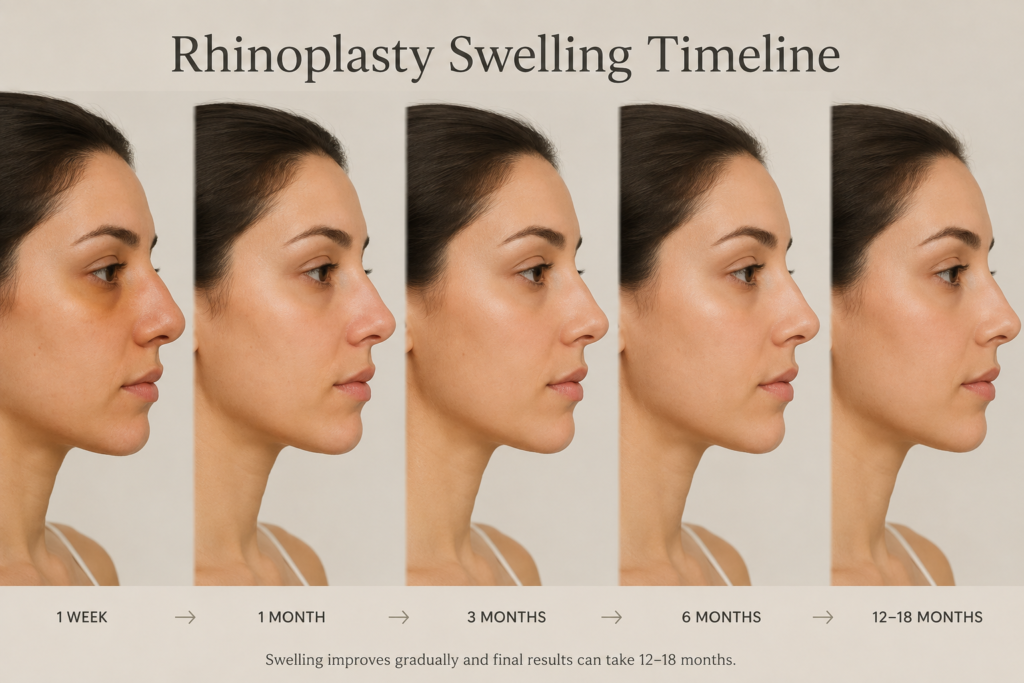
Rhinoplasty has one of the most prolonged swelling timelines of any facial procedure. For many patients, especially those who had tip work, the nose continues to change for 12 to 18 months post-surgery. Most of that timeline is lymphatic. And most patients are given no specific guidance on how to address it.
Lymphatic drainage after rhinoplasty is not a widely discussed part of recovery — but for patients who plateau weeks into healing, it is often the missing piece.
Why Rhinoplasty Swelling Lasts So Long
Rhinoplasty is one of the most technically demanding facial procedures precisely because the nose is such a structurally complex, tissue-dense area. The skin of the nasal tip — particularly in patients with thicker skin — has limited elasticity and a lymphatic network that is easily disrupted by surgical manipulation.
Research on rhinoplasty recovery timelines consistently documents that while most patients see significant improvement in swelling within the first four to six weeks, residual edema — particularly at the nasal tip — can persist for 12 to 18 months. In patients with thicker nasal skin, this timeline extends further.
The reason is specific: the lymphatic vessels of the nasal tip are fine, superficial, and highly susceptible to disruption during surgery. When these vessels are cut or traumatized, they must regenerate — a slow process that leaves the tip with reduced drainage capacity during exactly the period when the tissue most needs to clear inflammatory fluid.
The result is the prolonged swelling after rhinoplasty that so often frustrates patients. Many notice dramatic improvement during the first month, only to see progress slow afterward. During this phase, the nose—especially the tip—may appear bigger, rounder, or less refined than the underlying surgical result actually is.
What Lymphatic Drainage Does for Rhinoplasty Recovery
Professional manual lymphatic drainage after rhinoplasty addresses the specific physiological bottleneck that causes the post-rhinoplasty swelling plateau.
By manually activating the lymph node groups that drain the nasal and periorbital region — the parotid nodes near the ear, the submandibular nodes beneath the jaw, and the deep cervical chain along the neck — MLD creates a clear drainage pathway for the fluid that is sitting in the nasal tip and surrounding tissue. It does not force fluid out. It opens the system so that the body’s own lymphatic vessels can move fluid more efficiently than they currently can on their own.
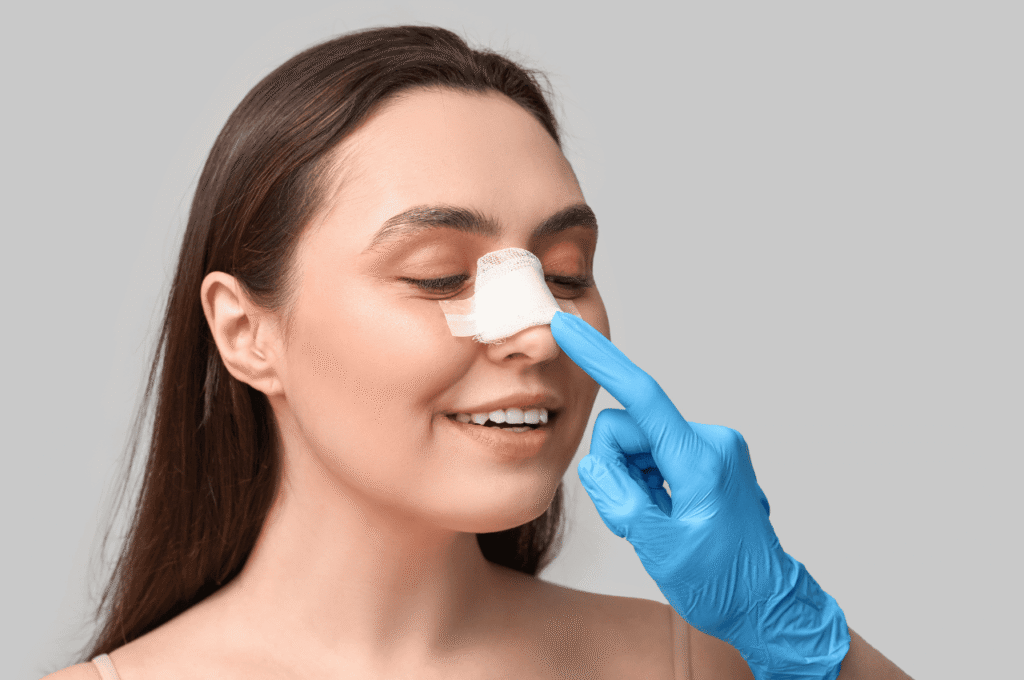
For rhinoplasty patients specifically, manual lymphatic drainage (MLD) addresses three things:
Nasal tip edema. The targeted drainage of the tip region, using extremely light pressure calibrated to the superficial lymphatic vessels, helps reduce the rounded, doughy appearance that persists long after the rest of the nasal swelling has resolved.
Periorbital swelling. Many rhinoplasty patients experience under-eye and lower eyelid swelling that extends well beyond the first two weeks. The orbital region and the nasal dorsum share lymphatic drainage territory — clearing one supports the other.
Skin thickness. In patients with thicker nasal skin, the skin envelope itself holds fluid more stubbornly than finer skin. Consistent MLD over a series of sessions helps reduce the fluid load in the skin envelope, allowing the refined nasal structure beneath to become visible sooner.
What Lymphatic Drainage Cannot Do After Rhinoplasty
Honesty matters here. Manual lymphatic drainage after nose surgery is not a substitute for good surgical technique, and it will not change the structural result of your rhinoplasty. If you are unhappy with the shape of your nose, MLD is not the answer — that is a conversation for your surgeon.
What MLD addresses is the fluid component of your swelling — the lymphatic congestion that is masking the result. In many cases, patients who have plateaued at six or eight weeks post-surgery and begin a series of MLD sessions find that the result they were expecting gradually becomes visible as the fluid clears. The surgery was always there. The swelling was obscuring it.
When to Start Lymphatic Drainage After Rhinoplasty — and How Often
Timing: Most rhinoplasty surgeons clear patients for gentle MLD between one and two weeks post-surgery, once initial bruising has stabilized, and there is no sign of hematoma or active bleeding. Do not begin manual lymphatic drainage (MLD) based solely on general recommendations; be sure to obtain approval from your surgeon before starting the procedures.
Early phase (weeks 2–6): 2 sessions per week. Focus on cervical clearance, periorbital drainage, and very gentle nasal tip work. Pressure is extremely light throughout — the nasal region is tender, and the vessels are fragile during this period.
Mid phase (weeks 6–12): 1–2 sessions per week. Fuller drainage sequence as the tissue becomes less reactive. Nasal tip work becomes more targeted as the area tolerates more direct attention.
Ongoing (beyond week 12): Monthly or bi-monthly maintenance for patients who want to continue supporting the remodeling process through the 12–18 month swelling timeline.
Most rhinoplasty patients benefit from 10–15 sessions in the first three months. Patients who begin early and are consistent with their protocol commonly report that their swelling resolves more quickly and more evenly than patients who do not receive MLD.
At Via Skincare, post-surgical lymphatic drainage in Los Angeles is performed using the Dr. Vodder method by a certified MLD specialist with experience in rhinoplasty and facial plastic surgery recovery.
If you are currently in recovery and feel like your swelling has stalled, or if you are planning your rhinoplasty and want to understand how to support your recovery from the start, we are happy to discuss your specific timeline and what a protocol for your situation would look like before you book.
Book your rhinoplasty recovery MLD session at Via Skincare, Los Angeles.
Frequently Asked Questions About Lymphatic Drainage After Rhinoplasty
How soon after rhinoplasty can I start lymphatic drainage?
Most surgeons clear patients for gentle MLD one to two weeks post-surgery. Always confirm with your surgeon directly — do not begin without their explicit clearance. Some approaches involving more extensive dissection may require a longer wait.
Will lymphatic drainage change the shape of my nose?
No. MLD addresses fluid — the lymphatic congestion sitting in the tissue. It does not affect the structural result of your surgery. What it may do is allow the result your surgeon created to become visible sooner, by reducing the swelling that is currently obscuring it.
My rhinoplasty was six months ago and I’m still swollen. Can MLD still help?
Yes. While earlier intervention produces better results, MLD is beneficial at any stage of rhinoplasty recovery. Residual edema at six months responds well to a consistent series of sessions. Book a consultation, have your tissue assessed, and your therapist will outline a realistic protocol for where you are in your recovery.
How is rhinoplasty MLD different from a regular facial?
Significantly. Post-surgical MLD uses the Vodder method — specific hand techniques, precise drainage sequence, and calibrated pressure matched to the lymphatic vessel physiology of healing tissue. A regular facial is not appropriate on post-surgical tissue and is not a substitute. The two are entirely different modalities.