

For many people, stress-related jaw tension becomes so familiar that they barely notice it until the muscles begin to ache or the face starts to feel constantly tight.
They notice it at the end of a difficult meeting, or when they catch themselves clenching in traffic, or when they wake up with a jaw so tight it takes the first hour of the morning to ease.
What most people don’t know is why this happens —and what persistent jaw tension from stress can do to the face over months and years of repetition.
The jaw is not simply an unfortunate storage location for stress. There is a neurological connection between emotional and behavioral responses and the muscles that control the jaw, and understanding that connection changes how you approach treatment — because jaw tension is rarely a purely muscular problem.
Why Does Stress Go to the Jaw?
The connection between stress and jaw tension is not just metaphorical. It has an anatomical basis.
The central nucleus of the amygdala — a region involved in coordinating behavioral and physiological responses to emotionally significant and threatening stimuli — has been shown to have structural connectivity with the trigeminal motor nucleus, the brainstem structure that controls the muscles of mastication.
In 2022, researchers used ultra-high-field diffusion MRI and probabilistic tractography to map this connection in humans for the first time, analyzing data from 30 healthy adults and replicating the finding across two field strengths. [1]
The researchers are careful to note that establishing exactly how this pathway functions during real-world stress is a task for future work — the study confirms the wiring exists, not precisely how it behaves moment to moment. [1] But the anatomy itself is interesting: structural connectivity between a region involved in coordinating responses to emotionally significant stimuli and the motor system controlling the jaw provides a neuroanatomical framework for understanding why emotional state and jaw muscle activity may be connected.

Exactly how this pathway functions during real-world psychological stress in humans remains to be established. What is already clear from the broader research is that psychological stress can be associated with increased masticatory muscle activity — and that jaw clenching often occurs without conscious awareness. This lines up with the broader clinical picture.
A 2026 scoping review examining 38 studies on psychological stress and masticatory muscle activity found that stress was associated with increased muscle activity across the large majority of the clinical studies reviewed, alongside all of the pre-clinical and cross-sectional studies included. [2] The authors are clear that the relationship is complex and that stress is only one factor among several that influence jaw muscle activity and pain. [2]
Taken together, this helps explain something many people experience firsthand: you may not consciously decide to clench your jaw, but your jaw can still become more active when your nervous system is carrying a sustained load. For many people, this makes jaw clenching less a matter of habit or willpower and more an automatic response that becomes more familiar to the nervous system the longer it’s reinforced — which is also part of why simply telling yourself to stop clenching so often falls short.
What Chronic Jaw Tension Can Do to Your Face Over Time
A jaw held in low-grade contraction for hours each day, month after month, year after year, does not necessarily stay the same. The masticatory muscles adapt to the load they’re placed under, the same way any repeatedly overworked muscle does.
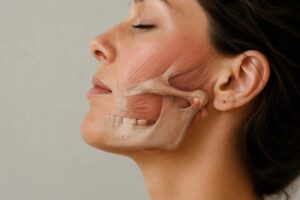
The masseter — the large muscle at the angle of the jaw that becomes firm when you clench — can gradually thicken with repeated overuse, contributing to more bulk through the lower face and a heavier appearance at the jaw angle. The temporalis can become chronically tense as well, contributing to tightness across the temples and side of the head.
The fascia surrounding these muscles appears to respond in much the same way. Fascia — the connective tissue that wraps and interweaves with muscle — is understood to thicken and lose some of its pliability under sustained tension, and in the face this kind of fascial restriction may contribute to the sense of compression and reduced mobility that clients often describe: a tightness that no skincare product reaches, and that lymphatic drainage alone may not fully resolve, since the restriction sits in the muscular and fascial layer rather than in the fluid compartment lymphatic work is designed to address.
The deeper jaw muscles can also contribute to discomfort felt beyond their exact location — temple, ear, or headache-adjacent pain patterns that are easy to misattribute to something else entirely. That connection between clenching and headache is its own topic, and we’ve covered it in more depth in TMJ Headaches, Jaw Clenching, and Bruxism: How They’re Connected and What Actually Releases Them.
The cumulative effect of all of this, for the face specifically, can be a face that looks — and feels — held. Tight through the jaw. Compressed through the lower cheeks. Effortful rather than at ease. For someone who has clenched for years, these changes can become so familiar they start to feel like simply “the way my face is.”
Why External Massage Alone Doesn’t Fully Resolve Stress-Driven Jaw Tension
External massage — working the masseter and temporalis from the skin surface — provides genuine relief. It increases circulation, reduces surface tension, and can create a real sense of release.
But some of the muscles most involved in a sustained clenching pattern are simply not reachable this way. The medial and lateral pterygoids lie deep within the masticatory system and cannot be directly contacted from the external surface in the same way as the masseter or temporalis — a point we go into further in Still Having TMJ Pain Despite Wearing a Night Guard?
This is where therapeutic buccal massage differs from a conventional external facial massage. Buccal massage — also called intraoral massage — uses gloved hands to work through the cheek and intraoral tissues, reaching the areas that external work can’t access. The goal isn’t to “sculpt” the face; it’s to work directly with the muscular tension that external massage alone can’t reach. For a closer look at how this differs from aesthetic facial work, see Buccal Massage for TMJ vs. Facial Sculpting: Which Is Right for You?
How Intraoral Massage May Affect the Nervous System
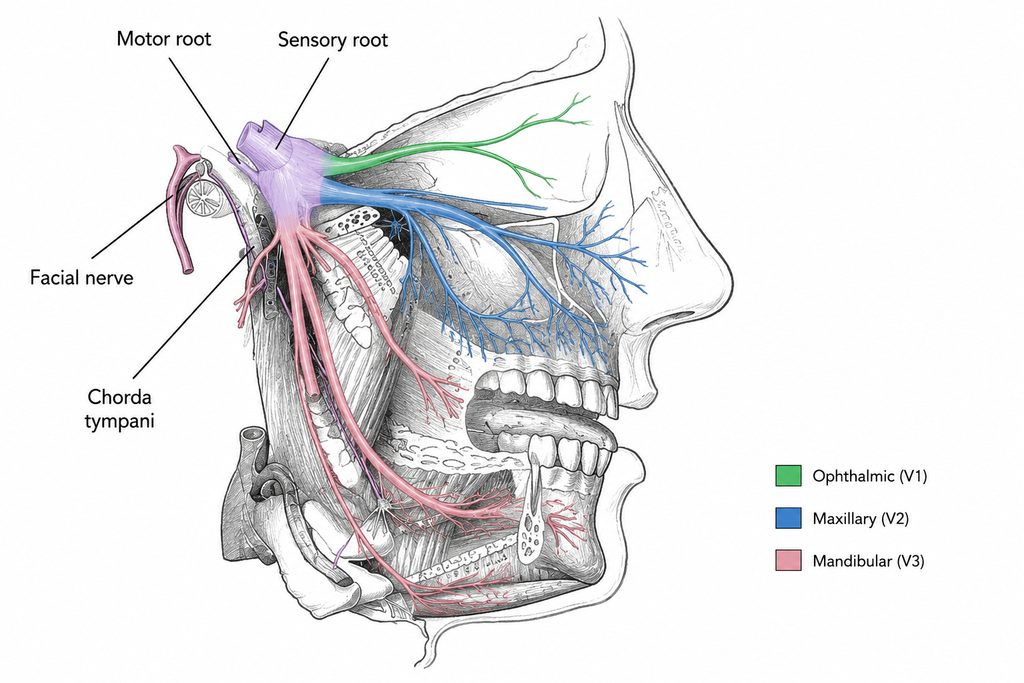
The trigeminal nerve is the largest cranial nerve and provides much of the sensory and motor innervation of the face, with extensive connections into brainstem structures involved in regulating the autonomic nervous system.
Intraoral massage provides sensory and mechanical input to tissues inside the mouth and areas of the masticatory system that cannot be contacted in the same way externally. Because the oral and facial tissues are densely innervated, this work also provides substantial sensory input to the trigeminal system.
Clients frequently report a noticeable sense of relaxation during or after intraoral work — less tension through the jaw, face, neck, and shoulders, and sometimes a sense of releasing a pattern they didn’t fully realize they were holding. Individual responses vary, and a client’s experience of relaxation shouldn’t be read as proof of any one specific mechanism. What’s clear is that jaw tension involves more than the condition of a single muscle — stress, sleep, concentration, emotional state, and learned oral habits can all play a role in how the masticatory system behaves. [1][2]
Reducing jaw tension usually takes more than an instruction to relax. It can mean addressing the muscles directly, building awareness of when clenching happens, reducing contributing stressors, and — when symptoms are persistent — working with the appropriate dental, medical, or physical therapy professional. Manual therapy can be one part of that process.
What This Means for How Your Face Looks and Feels
When the masticatory muscles genuinely release, the face can change in ways a topical product or surface treatment doesn’t produce. Some clients notice the jaw angle appears softer and the lower face looks less heavy or compressed as tension decreases.
The change isn’t the same for everyone — facial structure, age, genetics, muscle size, and the amount of chronic tension present all play a role in what’s visible. The aesthetic effect is best understood as a consequence of addressing the muscular and nervous system component of jaw tension, not as a lifting procedure in its own right.
If your primary concern is jaw tension, clenching, or muscular discomfort, focused intraoral work may be the more appropriate starting point. If your primary goal is broader facial lifting and rejuvenation across the whole face, our Reconstructive Facelift Massage (RFL) is designed for that purpose instead.
When Jaw Tension Should Be Evaluated
Not every jaw problem is a stress problem. Persistent jaw pain, significant difficulty opening or closing the mouth, locking, swelling, trauma, painful clicking, or a noticeable change in your bite should be evaluated by an appropriate dental or medical professional — manual therapy isn’t a substitute for diagnosis when symptoms call for one. For general background on jaw joint and muscle disorders, the National Institute of Dental and Craniofacial Research maintains a helpful overview. [3]
Common Questions About Stress and Jaw Tension
Can stress cause jaw tension?
Yes. Psychological stress can influence activity in the muscles used for chewing — research on masticatory muscle activity has found a consistent relationship between stress and increased muscle activity, though individual responses vary and the mechanisms are still being worked out. [2]
Why does my jaw feel tight when I’m stressed?
Stress can influence both muscle activity and behaviors like clenching. Some people become more aware of jaw tension during concentration, anxiety, or emotional stress; others clench without noticing at all.
Why do I clench my jaw without realizing it?
Because jaw clenching can become an automatic motor pattern rather than a conscious decision. Stress, concentration, anxiety, emotional strain, and sleep can all increase jaw muscle activity, and many people don’t notice they’re clenching until they feel soreness, fatigue, or tension in the jaw or temples.
Can chronic jaw tension change the shape of my face?
It can. In people who frequently clench their jaw, increased masseter activity and chronic muscle tension can make the jaw angle and lower face appear heavier over time. How noticeable this is depends on individual anatomy and how much tension is present.
What is intraoral or buccal massage?
Buccal massage, also called intraoral massage, is a manual technique that works with the muscles and soft tissue of the face and jaw from inside the mouth, reaching areas that can’t be contacted the same way externally. For a full introduction, read What Is Buccal Massage? Everything You Need to Know Before Your First Session.
Book Therapeutic Buccal Massage in Los Angeles
If jaw tension, stress-related clenching, or persistent tightness through the lower face is what brought you here, therapeutic buccal massage may be an appropriate place to start.
At Via Skincare, buccal massage is approached as therapeutic intraoral work for the muscles and soft tissue of the jaw and face — not simply as a facial sculpting technique. If you’re unsure whether it’s the right fit for your situation, contact us before booking; we’d rather help you find the right starting point than have you book something that doesn’t match your primary concern.
Book a Buccal Massage at Via Skincare
Sources
[1] Kaya B, Geha P, de Araujo I, Cioffi I, Moayedi M. Identification of central amygdala and trigeminal motor nucleus connectivity in humans: An ultra-high field diffusion MRI study. Human Brain Mapping. 2023;44(4):1309–1319. Read the full study
[2] Weden A, Koutris M, van der Meer H. The effect of psychological stress on masticatory muscle electromyography—a scoping review. Journal of Oral & Facial Pain and Headache. 2026;40(4):9–18. Read the full review
[3] National Institute of Dental and Craniofacial Research. Temporomandibular Disorders (TMD). Read the NIDCR overview of TMD



Pingback: TMJ Headaches, Jaw Clenching & Bruxism Relief in Los Angeles
Pingback: TMJ Pain Despite a Night Guard? Jaw Tension Explained
Pingback: Buccal Massage: 5 Myths Explained | Via Skincare