
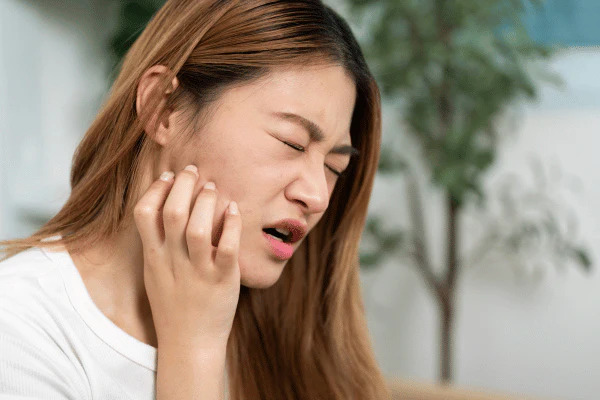
You might have come to this page for the headaches. Or the jaw aching. Or because your partner told you that you grind your teeth at night, loudly enough to hear it from across the room.
What most people don’t realize is that these are not three separate problems. They are three expressions of the same underlying pattern — a chronically overloaded jaw system that is telling you, through different symptoms at different times, that it needs attention.
Understanding why they’re connected is the first step toward actually resolving them. Because the treatments that address each symptom in isolation — pain medication for the headaches, a night guard for the grinding, stretching exercises for the clenching — rarely quiet the system in any lasting way. They manage individual signals without addressing what is generating them.
Why Does TMJ Dysfunction Cause So Many Different Symptoms?
The temporomandibular joint sits at a structural crossroads between the neck, the skull base, and the facial bones. Dysfunction here sends ripple effects in multiple directions simultaneously — which is why the same underlying condition can show up as jaw pain in one person, chronic headaches in another, and unexplained ear pressure in a third.
The joint itself is less often the primary problem than the muscles surrounding it. The masticatory muscles — the masseter, temporalis, medial pterygoid, and lateral pterygoid — are what actually move the jaw, and they bear the full consequences of chronic overuse, stress, and structural imbalance. When these muscles become hypertonic, they generate trigger points that refer pain well beyond the jaw itself.
The result is a cascade of symptoms that most people experience as separate complaints — headaches, ear pain, facial pressure, jaw soreness — without recognizing them as expressions of the same overloaded system. If you’d like a detailed breakdown of each masticatory muscle, why the pterygoids are so difficult to reach, and why a night guard alone cannot resolve this, we cover all of that in Still Having TMJ Pain Despite Wearing a Night Guard? This post focuses specifically on how that muscular dysfunction generates the three most common and misunderstood symptom patterns: headaches, clenching, and grinding.
What Causes TMJ Headaches and Where Is the Pain Coming From?
Headaches are among the most commonly reported symptoms of TMJ dysfunction, yet they are also among the most frequently misdiagnosed. People spend years treating what they believe are tension headaches, migraines, or sinus headaches — cycling through medications, specialist referrals, and elimination diets — without anyone examining the jaw as a contributing source.
The mechanism is well established. The temporalis muscle — a broad, fan-shaped muscle that originates across the side of the skull and inserts on the coronoid process of the lower jaw — is a primary jaw-closing muscle. When it is chronically contracted, it creates referred pain across the temporal region: a diffuse, pressing headache that sits at the side of the head and often extends toward the eye socket, the forehead, or the back of the skull.
The masseter contributes similarly. Trigger points in the masseter refer pain into the lower jaw, teeth, cheek, and ear — creating patterns that are frequently attributed to dental pain or ear infections in the absence of any identifiable dental or ear pathology.
The lateral pterygoid, the deep muscle controlling jaw opening and disc movement, generates referred pain into the TMJ region itself and into the ear. Its involvement is often what produces the sense of fullness, pressure, or pain deep inside the ear that many TMJ sufferers describe — a symptom that sends people to ENT specialists who find nothing structurally wrong with the ear.
All of this referred pain has a single origin: hypertonic masticatory muscles generating ischemic trigger points that radiate discomfort into surrounding and distant regions. Treating the headache with analgesics addresses the signal without touching the source. The headache returns because the muscle generating it has not changed.
Why Do I Clench My Jaw — and How Do I Stop?
Jaw clenching is one of those habits that becomes visible only in retrospect. People notice it at the end of a long meeting, or when someone points out that their jaw is set. They realize, with some surprise, that it has been clenched for the last hour without any conscious intention to do so.
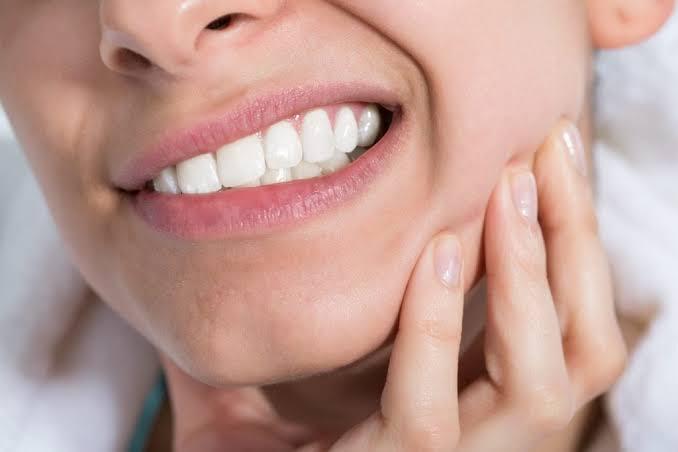
This involuntary quality is important. Clenching is largely a stress-mediated neuromuscular response — a pattern the nervous system adopts when under sustained psychological or physical load. The jaw, along with the shoulders and the diaphragm, is one of the primary sites in the body where unprocessed tension consolidates. This is not metaphorical. The trigeminal motor system — the neural pathway governing jaw movement — is directly influenced by the limbic system, which governs emotional processing and the stress response.
We explore the research behind this stress–jaw connection, and how repeated clenching may affect the lower face over time, in Your Jaw Holds Your Stress. Here’s What That’s Actually Doing to Your Face.
What this means practically is that telling yourself not to clench is about as effective as telling yourself not to feel anxious. The instruction originates in the conscious, cortical brain. The clenching is driven by a subcortical pattern that does not respond to conscious override in any reliable way.
What does respond is direct work on the muscular tissue combined with repeated therapeutic input that helps the nervous system recalibrate its baseline resting tone over time. This is why manual therapy — particularly intraoral technique that accesses the pterygoids and deep masseter — can produce lasting reductions in clenching that relaxation exercises and behavioral reminders cannot. The change happens at the level of the tissue and the nervous system, not at the level of intention.
What Is Bruxism and How Is It Different From Jaw Clenching?
Bruxism — grinding the teeth during sleep — is the nighttime expression of the same underlying hypertonicity that drives daytime clenching. The masticatory muscles, unable to discharge their accumulated tension during waking hours, do so during sleep in the form of sustained or rhythmic grinding movements that the sleeper has no awareness of.
The muscular consequences of bruxism compound over time. The masseter, subjected to chronic grinding forces far in excess of normal chewing loads, gradually hypertrophies — thickening and shortening in a way that progressively restricts jaw range of motion, loads the TMJ joint, and contributes to the facial heaviness in the lower third that many bruxers notice over years.
The pterygoids, working to execute the lateral grinding movements of bruxism, develop chronic trigger points and fascial restrictions that accumulate session after session, night after night, in the absence of any therapeutic intervention.
A night guard — as we discussed in Still Having TMJ Pain Despite Wearing a Night Guard? — protects the tooth surfaces from this grinding load. It does not interrupt the muscular activity itself, which continues unimpeded through the appliance. This is why bruxers who have worn night guards faithfully for years still present with hypertrophied masseters, restricted jaw opening, and chronic muscle tenderness. The protective barrier was in place; the muscle was still grinding.
Are TMJ Headaches, Clenching, and Grinding Actually the Same Problem?
Seen together, the picture is clear. Chronic stress loads the masticatory muscles beyond their normal resting tone. Daytime clenching accumulates tension during waking hours. Nighttime bruxism continues the process during sleep. The muscles — never fully released, never allowed to return to normal resting length — develop trigger points that refer pain into the head, temples, ears, and face.
The headaches are not caused by something in your head. The ear pain is not caused by something in your ear. The jaw soreness in the morning is the most honest signal of the three — the one closest to its actual source. But all three are expressions of the same overloaded, undertreated muscular system.
What changes the pattern is not suppression of individual symptoms. It is direct, repeated work on the muscles themselves — including, critically, the muscles that are only accessible from inside the mouth.
How Does Intraoral Massage Treat TMJ, Clenching, and Bruxism?
As we explain in Still Having TMJ Pain Despite Wearing a Night Guard?, the medial and lateral pterygoids are accessible from only one direction: through the mouth. This single anatomical fact explains why so many TMJ sufferers cycle through external treatments — massage, physical therapy, Botox — without lasting resolution. You cannot change a muscle you cannot reach.
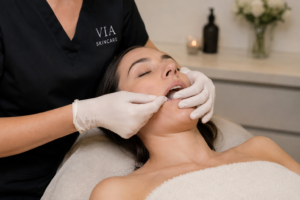
Buccal massage reaches them. Working with gloved hands through the cheek tissue, a trained therapist accesses the deep masseter, the pterygoids, and the surrounding fascia directly — deactivating trigger points at their source rather than working around them.
What changes over a series of sessions is progressive and cumulative. The resting tone of the masticatory muscles decreases. The trigger points generating referred headache pain become less reactive. The clenching reflex — deprived of the tight, ischemic tissue that reinforces it — begins to moderate. Clients who have ground their teeth for years find their morning jaw soreness diminishing. Headaches become less frequent and less severe. The grinding quiets.
This is not an immediate fix. It is a gradual reset of a pattern that took years to establish — but it is the kind of change that addresses the condition rather than managing its symptoms. For full detail on what a session involves and what to expect, visit our buccal massage service page.
For specific guidance on session frequency and what a course of treatment typically looks like, see the FAQ on our buccal massage page.
Can TMJ Pain Be Mistaken for Ear Pain or Sinus Problems?
If you have been told that your ear pain, sinus pressure, or eye socket aching has no identifiable cause — and you also carry jaw tension or have a TMJ history — it is worth considering the masticatory muscles as a contributing source before pursuing further specialist investigation.
This is not a suggestion to avoid medical evaluation of symptoms that warrant it. It is an observation, grounded in clinical experience, that a significant number of clients arrive at Via Skincare carrying diagnoses of idiopathic headache, unexplained ear pressure, or chronic facial pain that substantially improves — sometimes resolves — once the masticatory system is properly addressed.
The jaw is a more central structure than it appears. When it is chronically overtaxed, its effects travel. When it is properly treated, the relief often travels too.
Book TMJ Headache and Jaw Pain Treatment in Los Angeles
At Via Skincare, located in Studio City, Los Angeles, we were the first to offer buccal massage in California, with nearly a decade of clinical experience in intraoral technique and TMJ-focused manual therapy. Book a buccal massage session with us and experience what it means to address the masticatory muscles directly.
If you’d like more context before booking, these two posts cover the full picture:
Still Having TMJ Pain Despite Wearing a Night Guard? — on why the muscular component of TMJ needs direct therapeutic work that a mouth guard cannot provide.
What Buccal Massage Actually Does — And Why “Natural Facelift” Misses the Point — on the therapeutic mechanism behind intraoral massage and who it’s genuinely right for.
Questions about your specific situation? Contact us — we’d rather help you understand whether this is the right approach before you book.



Pingback: Buccal Massage: 5 Myths Explained | Via Skincare
Pingback: Buccal Massage for TMJ vs Facial Sculpting | Via Skincare
Pingback: Jaw Tension From Stress: How Clenching Can Affect Your Face