If you search “buccal massage” right now, you’ll find pages of before-and-after photos, promises of sculpted cheekbones, and the phrase “natural facelift” used so freely it has lost all meaning.
We want to tell you something different.
At Via Skincare, we introduced buccal massage to California in 2016. We have treated jaws, TMJ dysfunction, chronic facial tension, and the full range of conditions that bring people through our door in Studio City. And over nearly a decade of practice, the pattern we see most consistently is this: the people who benefit most from buccal massage are not primarily seeking a facelift. They are seeking relief.
That reframing matters — not just for accuracy, but because it changes who knows to book this treatment, what they expect from it, and whether they get the outcome they actually need.
What Buccal Massage Is, Anatomically Speaking
Buccal massage — also called intraoral massage — is a manual therapy technique that accesses the muscles of the face from inside the mouth.
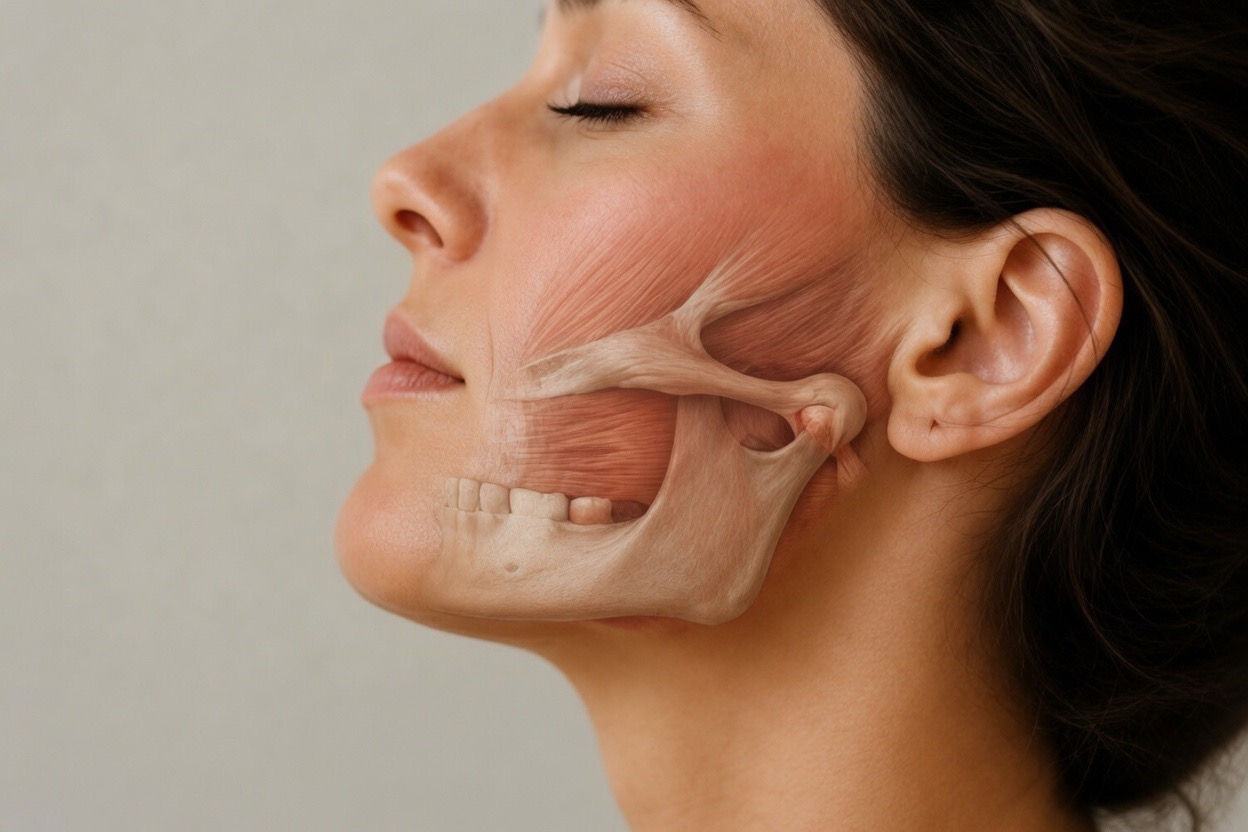
That last part is important. The jaw is operated by a group of muscles collectively called the masticatory muscles. The primary ones are the masseter (the large muscle you feel when you clench your back teeth), the temporalis (which runs up the side of the skull), and the medial and lateral pterygoids — two deeper muscles that control the opening, closing, and lateral movement of the jaw.
The pterygoids, in particular, are inaccessible from the outside. You cannot reach them through the skin. No amount of external facial massage, tool-assisted technique, or gua sha addresses them directly. Temporomandibular joint dysfunction — the condition most commonly associated with jaw pain, clicking, limited range of motion, and referred headaches — involves these muscles at its root.
Buccal massage reaches them. That is its defining clinical value.
By working through the mouth with gloved hands, a skilled therapist can apply direct pressure and release techniques to the pterygoids, the deep masseter, the buccinator, and surrounding fascia in a way that no other manual therapy approach can replicate. The result is a release of neuromuscular holding patterns that, in some clients, have been present for years.
This is what buccal massage actually does. It is not primarily a skin treatment. It is not primarily a contouring treatment. It is a deep muscular intervention in one of the most chronically overtaxed and underserved areas of the body.
Why “Natural Facelift” Is the Wrong Frame
The aesthetics industry attached itself to buccal massage quickly, and the “natural facelift” framing is largely why. It’s a more marketable story than jaw muscle release. It photographs better. It sells more easily to a beauty audience.
But it is not the treatment’s primary mechanism — and calling it that does a disservice to the clients who most need it.
Here is what is actually happening when buccal massage appears to produce a lifting or contouring effect: the masticatory muscles, when chronically contracted, pull downward on the soft tissue of the lower face. The masseter in particular, when hypertrophied from years of clenching or grinding, creates bulk at the jaw angle and contributes to a heaviness in the lower third. When those muscles release, the tissue above them responds. Circulation improves. The face looks less compressed, more defined, more at ease.
That is a real and welcome outcome. But it is the consequence of therapeutic work, not the purpose of it. And it is specific — it affects the lower third of the face, in proportion to how much chronic tension was present. It is not a comprehensive lifting of the midface, brows, or upper third. Anyone suggesting otherwise is overpromising.
We say this not to diminish the treatment, but to be accurate about it. Accuracy is what builds trust — and trust is what produces clients who come back and refer their friends.
If comprehensive facial lifting, structural rejuvenation, and addressing volume loss across multiple facial zones is your primary goal, that is exactly what our Reconstructive Facelift Massage was developed to do. The RFL is a complete methodology that works across all layers of the face — skin, fascia, muscle, and lymphatic circulation — as an integrated system. It is the appropriate treatment when lifting is the intention. Many clients eventually benefit from both, but they serve genuinely different purposes.
For help deciding which treatment better matches your goal, read Buccal Massage for TMJ vs. Facial Sculpting: Which Is Right for You?
Who Buccal Massage Is Actually For
With the framing corrected, the picture of who benefits becomes much clearer.
You are a strong candidate for buccal massage if you:
- Experience jaw pain, tightness, or fatigue — especially after waking, eating, or prolonged stress. These are signs your masticatory muscles are working harder than they should, often chronically and without your awareness.
- Have been diagnosed with TMJ dysfunction and found that conventional approaches — night guards, anti-inflammatories, physical therapy — provide incomplete or temporary relief. Night guards protect your teeth from wear. They do not release the muscular tension that drives clenching in the first place.
- Clench or grind your teeth, whether during sleep or unconsciously during the day. Bruxism creates progressive shortening and thickening in the masseter and pterygoids. Without intervention, that pattern deepens over time and begins to affect surrounding structures — the TMJ capsule, the cervical spine, the temporal region.
- Experience headaches that originate at the temples, base of the skull, or behind the eyes and have not responded fully to other treatment. Referred pain from the pterygoids and masseter is a well-documented phenomenon and is frequently misattributed to tension headaches of unspecified origin.
- Carry tension in your face and jaw during periods of stress, even if you don’t have a formal TMJ diagnosis. Chronic emotional and psychological tension finds its way into the jaw with remarkable consistency — it is one of the primary sites in the body where we hold what we cannot express. A buccal massage session often produces a profound parasympathetic shift that goes well beyond the jaw itself.
- Notice a heaviness or compression in your lower face that doesn’t improve with skincare, lymphatic work, or other facial treatments. This can be the specific presentation of hypertonic masticatory muscles — and no external technique resolves it the way intraoral work does.
What to Expect: Honest, Not Glamorized
A buccal massage session at Via Skincare begins with a brief assessment of your jaw, range of motion, and any relevant history — dental, medical, or otherwise. We want to understand what brought you in, not just what you want to leave looking like.
The session moves from external work first — neck, shoulders, and the outer face — to prepare the surrounding tissue and promote circulation before going deeper. The intraoral component involves gloved fingers working methodically through the cheek tissue, along the masseter, and into the pterygoid region. The level of sensation varies considerably depending on how much tension is present and how long it has been there.
Most clients describe a distinctive combination: moments of significant pressure or intensity in particular spots, followed by a release that often produces an immediate sense of relief and spaciousness in the jaw. The first session is typically the most intense. By the third or fourth, the muscles have begun to change, and the work becomes progressively more comfortable.
For a complete first-visit overview, read What Is Buccal Massage? Everything You Need to Know Before Your First Session.
You will leave with improved jaw mobility in most cases, reduced pain or pressure, and a quality of relaxation that is different from a surface facial — more somatic, more whole-body. Some clients describe feeling noticeably different in the hours after a session: calmer, looser through the neck and shoulders, clearer-headed. This is not incidental. The trigeminal nerve — the largest cranial nerve, and the primary sensory nerve of the face — runs through the tissue we are working with. Releasing chronic tension in this region has effects that extend well beyond the jaw.
How Many Sessions, and How Often
There is no honest universal answer to this. What we can offer is a general framework.
For acute tension or a specific presenting complaint — jaw soreness before a big event, post-dental work discomfort, or a flare of TMJ symptoms — a single session often provides meaningful short-term relief.
For chronic TMJ dysfunction, habitual bruxism, or long-standing masticatory tension, a series of sessions is more appropriate. We typically suggest four to six sessions, spaced one to two weeks apart initially, to allow the muscles to change progressively rather than simply responding to repeated temporary releases. After the initial series, many clients maintain with monthly or six-weekly sessions depending on their stress levels and symptom patterns.
We will give you an honest assessment at your first session rather than a preset protocol. Your jaw has its own history, and the plan should reflect that.
A Note on the Aesthetic Dimension
We have been clear that buccal massage is not a facelift. But we do not want to dismiss the aesthetic dimension entirely — that would also be inaccurate.
When the masticatory muscles release from a chronically contracted state, the lower face does change. The jaw angle often becomes less heavy. The tissue through the cheeks softens and redistributes. Circulation improves visibly. The face, overall, looks less held and more alive. These are real outcomes, and they matter to our clients.
They are simply not the headline. They are what happens when the body is treated honestly and the underlying dysfunction is addressed. The appearance follows the function. That is the order we work in, and it is the order that produces lasting results rather than temporary ones.
If you would like to understand whether buccal massage is the right starting point for what you are experiencing — or whether the Reconstructive Facelift Massage would serve your goals better — we are always happy to have that conversation before you book.
Ready to Experience It?
Book a buccal massage session with Via Skincare located in Studio City, Los Angeles.
If you are a licensed esthetician or massage therapist interested in learning this technique, our Advanced Buccal Massage Training offers a deep clinical dive into intraoral technique, anatomy, and TMJ-focused application. For practitioners who want buccal massage as part of a complete facial lifting methodology, the Reconstructive Facelift Massage Training is where that work begins.
Have questions about whether buccal massage is right for your situation? Contact us — we’d rather you come in with the right expectations than come in disappointed.




Pingback: Buccal Massage for TMJ vs Facial Sculpting | Via Skincare
Pingback: Buccal Massage: 5 Myths Explained | Via Skincare