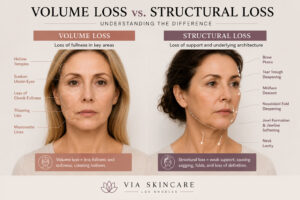

There’s a version of aging that happens slowly and gracefully — fine lines that arrive with expression, a softening that reads as lived-in rather than diminished. Most people don’t mind that version. What they do mind is something else: the jaw that’s losing its edge, the cheeks that seem to be sliding south, the face that looks heavier and less like itself even when nothing specific has changed.
That second thing has a name, even if nobody uses it. It’s structural collapse — and it’s not the same as aging.
Knowing the difference changes everything about how you approach it.
Aging Is a Process. Collapse Is an Event.
True facial aging is gradual and largely symmetrical. It’s the cumulative effect of collagen and elastin declining over decades, sun exposure adding up, and the natural thinning of skin that comes with time. These changes are real, and no skincare routine reverses them entirely. But they tend to happen slowly, and a face that’s simply aging still holds its fundamental architecture.
Structural collapse is different. It often feels sudden — even though it isn’t. It’s the moment when the underlying support system of the face has been quietly failing long enough that the surface can no longer hide it. What you see is a face that looks like it’s giving way rather than simply getting older. The jawline blurs. The lower face looks heavy. The midface flattens. Features that were once defined look like they’ve been smudged.
The distinction matters because the causes are different — and so are the solutions.
What Holds the Face Up
To understand collapse, you need to understand what the face is actually resting on.
The face is a layered structure. Skin sits over subcutaneous fat, which sits over fascia, which wraps around muscle, which is attached to bone. In a young face, every one of these layers is doing its job. Fat pads sit high in the cheeks, providing volume and lift. Muscles maintain their tone and hold the overlying tissue in position. The fascia — the connective tissue web that connects everything — is elastic and mobile. The jawbone and cheekbones provide the structural framework that the whole system drapes over.
As we age, each of these layers changes. But they don’t all change at the same rate, and they don’t all change for the same reasons. When they fail together — or when lifestyle and tension accelerate the process — the result isn’t just aging. It’s collapse.
The Three Things That Drive Collapse Specifically
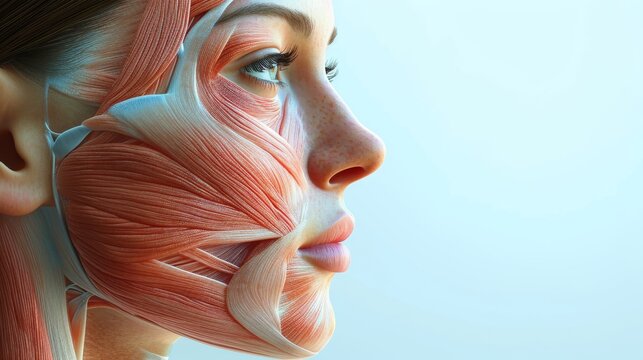
1. Muscle contracture and atrophy — happening at the same time
This is one of the more counterintuitive aspects of how faces change. Research published in PMC/NIH confirms that facial aging involves a paradox: some facial muscles become chronically over-contracted and shortened from years of expression and tension, while others quietly atrophy from disuse. Both processes reshape the face from the inside.
Shortened muscles pull features downward and inward — deepening folds, compressing tissue, and altering the resting position of the face. Atrophied muscles lose the upward-support capacity that once kept the cheeks lifted and the jawline defined. The face doesn’t just lose volume. It loses its internal structure.
This is why chronic jaw tension and TMJ-related tightness often show up visually in the face long before they cause any pain. The masseter muscles, when chronically overloaded, alter how the entire lower face sits.
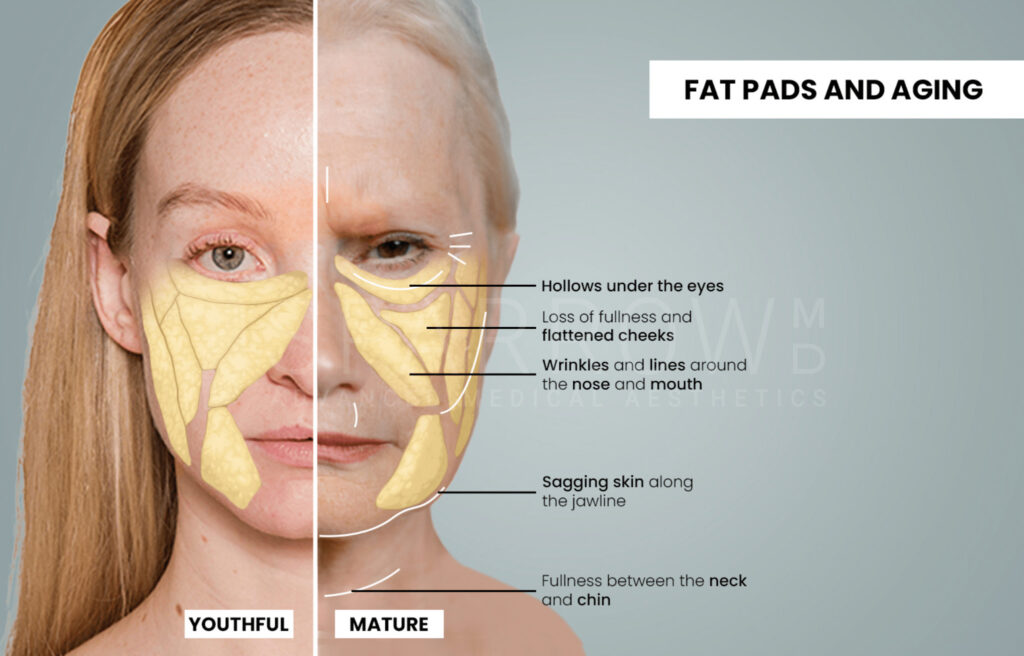
2. Fat pad migration — not disappearance
The face contains distinct pockets of fat positioned to give it fullness, lift, and definition. These fat pads don’t simply vanish with age — they migrate. The deep cheek fat deflates and shifts downward while the ligaments that once anchored everything in place gradually weaken. Volume is lost in the midface precisely where it’s most needed for lift, and it accumulates along the jawline where it creates jowling.
This is why the same face can look simultaneously hollow in the cheeks and heavy along the jaw. It’s not a contradiction — it’s the same fat pad that’s moved.
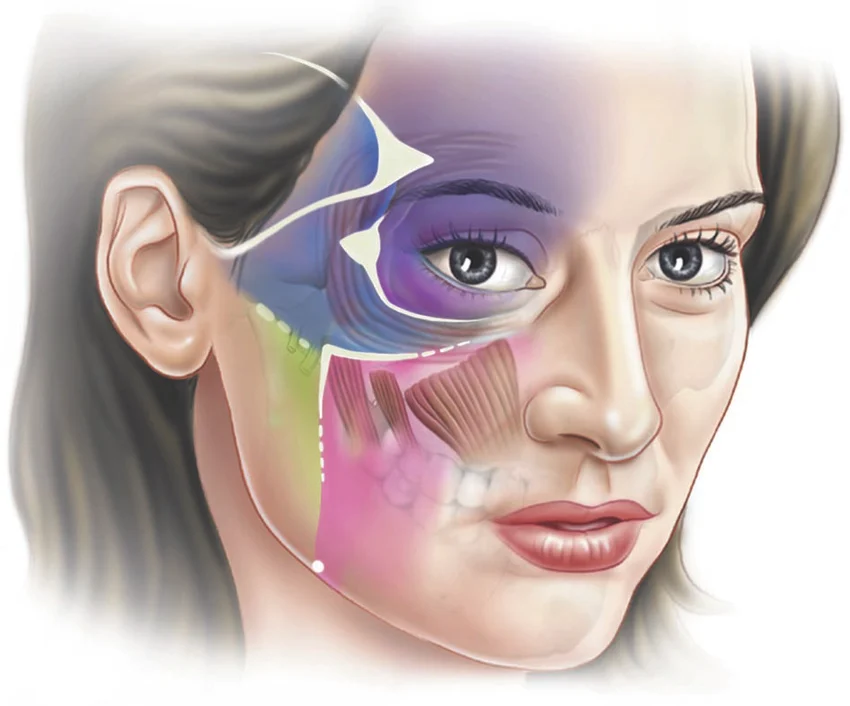
3. Fascia that’s lost its glide
Between every layer of the face, fascia acts as a mobile connective interface — allowing muscles, fat, and skin to move independently of each other. When fascia tightens and forms adhesions, these layers get stuck together. Structures that should float begin to drag. Features that should stay lifted get pulled down by the accumulated tension of years of stress, inflammation, and disuse.
A 2022 study published in Skin Research and Technology used CT imaging to demonstrate that facial massage produces measurable shifts in the SMAS — the deep fascial layer that surgical facelifts directly target — confirming that manual work can influence these structures in ways topical treatments simply cannot reach.
Where Tension Enters the Picture
One factor that accelerates collapse more than most people realize is chronic muscular tension — particularly in the jaw, neck, and lower face.
When the body is under sustained stress, the nervous system increases resting muscle tone in protective areas. The jaw tightens. The neck contracts. The face begins to hold an expression of strain even at rest. Over time, this creates the kind of chronic shortening and fascial restriction that pulls features downward long before natural aging would have gotten there. Chronic slouching literally collapses mid-face architecture — contributing to sagging jawlines, deepened folds, and facial asymmetry through a mechanical process, not a biological one.
This is the face that looks ten years older than it should. Not because aging has run its natural course, but because tension, posture, and structural failure have accelerated it.
What Addresses Aging vs. What Addresses Collapse
Serums, retinoids, and good skincare address the dermal layer — and they do it well. But they can’t release a fascial adhesion, restore muscle tone, reposition a migrated fat pad, or decompress a neck that’s been shortened by years of forward head posture.
Surgery repositions and tightens — but as one New York dermatologist observed in a recent interview, a facelift repositions tissue and tightens skin, but it doesn’t rebuild the deeper structures.” It addresses the drape, not the frame.
What addresses collapse at its structural source is manual therapeutic work — specifically, techniques that reach the muscular, fascial, and lymphatic layers where the failure is actually occurring. At Via Skincare, our Reconstructive Facelift Massage is built precisely around this: working the muscles, fascia, and deeper connective tissue of the face and neck to restore the internal support that products and injectables can’t touch. Each session combines manual lymphatic drainage to clear the congestion that adds heaviness, myofascial release to restore glide between tissue layers, and targeted work on the neck and jaw — because as we’ve written before, sagging skin isn’t just a skin problem.
A More Useful Way to Look at Your Face
If your face feels like it’s giving way rather than simply maturing, the question worth asking isn’t “what can I put on it?” It’s “what’s happening underneath it?”
A face that’s collapsing is telling you something about its structure — its muscles, its fascia, its posture, the way it’s been carrying tension for years. That’s not a message that a serum can answer.
At Via Skincare in Los Angeles, our Reconstructive Facelift Massage is designed to address facial aging at its structural root — not just its surface. Book a consultation to understand what your face actually needs.