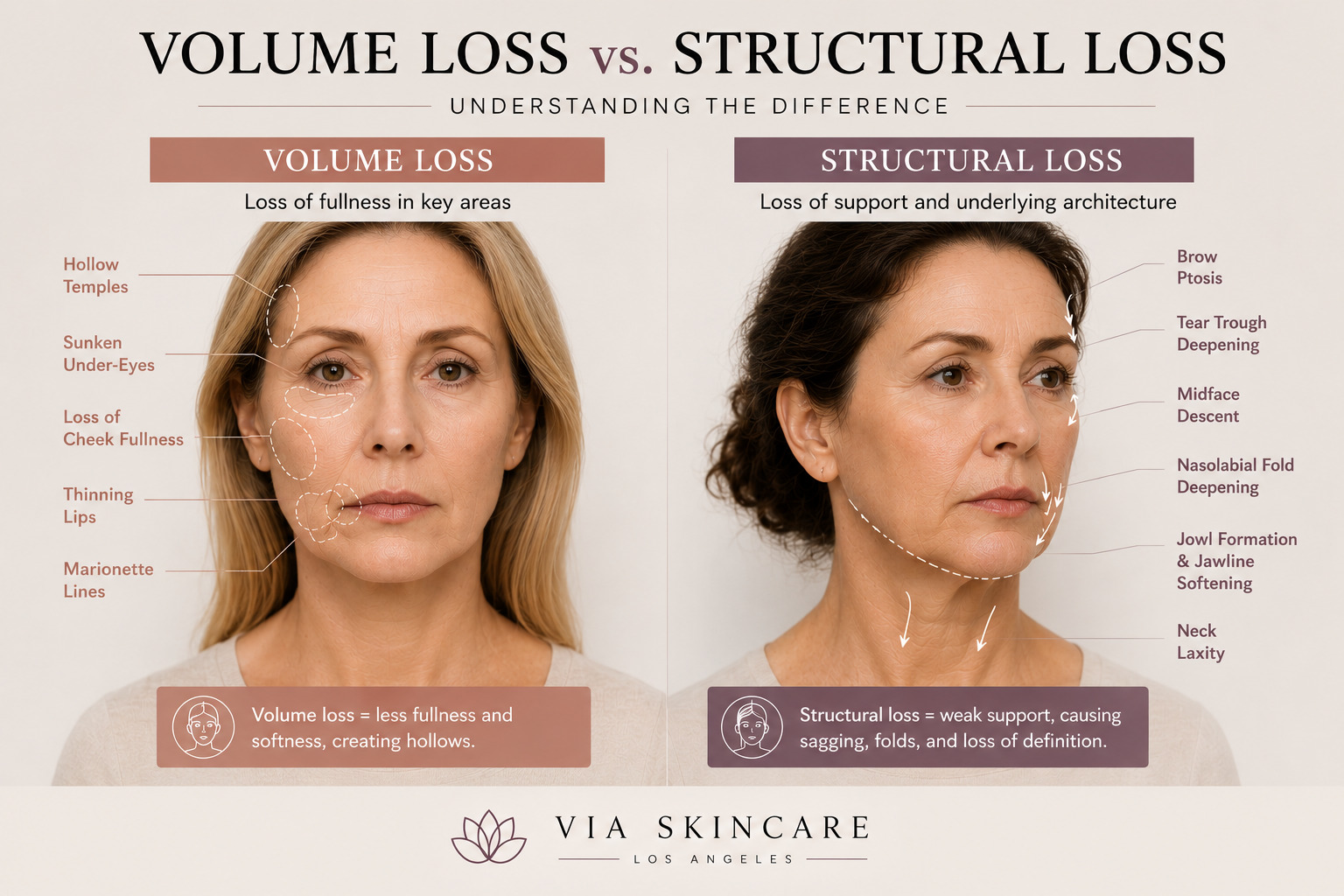
The word “volume” has become the default explanation for almost everything that changes in an aging face. Hollow cheeks? Volume loss. Deepening smile lines? Volume loss. A face that looks flatter, heavier, less defined than it did a decade ago? Volume loss. The solution that follows is almost always the same: replace what’s missing with filler.
It’s a tidy story. It’s also incomplete — and for a lot of people, acting on it without understanding the full picture is why their results feel temporary, or slightly off, or not quite right in a way they can’t articulate.
The face isn’t a container that gradually empties. It’s a structure. And what most people are experiencing isn’t a deficit of material. It’s a breakdown in the system that holds everything in place.
The Architecture Analogy
Think of a well-built building. What gives it its shape isn’t just the material inside — it’s the frame, the load-bearing walls, the relationship between structural elements that allows each part to stay where it belongs. If the frame shifts, the facade doesn’t fit properly anymore. You can fill gaps in the exterior all you want, but the problem is in the underlying structure.
The face works the same way. Facial aging reflects the dynamic, cumulative effects of time on the skin, soft tissues, and deep structural components — a complex interplay of skin changes, soft tissue descent, and volume redistribution. When that interplay breaks down, the face doesn’t simply lose material. It loses the system that kept everything in its right position.
What’s Actually Changing — Layer by Layer
The Bone
Most people don’t know that the facial skeleton changes shape throughout adult life. The aging craniofacial skeleton undergoes an appreciable reduction in facial height, mainly due to changes in the maxilla and mandible, while the orbits increase in size — compounding the downward displacement of the cheek fat pad and the deepening of nasolabial folds.
This matters because the bones are the foundation everything else rests on. When that foundation recedes — at the jaw, the cheekbones, the orbital rims — the soft tissue above it has less to hold onto. According to Wolff’s law, well established in orthopedics, bone remodels in response to mechanical stress — meaning weakened facial musculature, which reduces tensile forces on osseous attachments, directly accelerates bone resorption in aging. The skeleton and the muscles that cover it are in conversation. When one weakens, the other follows.
The Fat
The face has distinct, compartmentalized fat pads — not a uniform layer, but separate pockets positioned strategically to provide lift, fullness, and definition in specific areas. These fat compartments don’t behave uniformly with age: deep fat pads, compressed against bone and serving as sliding interfaces for the muscles above them, tend to selectively atrophy over time, while superficial fat pads, located near the dynamic muscles of facial expression, behave differently.
The practical result is a face that looks simultaneously hollow in the midface and heavy along the jaw — not because fat has disappeared, but because it has moved. The fat pads that deflate and descend often accumulate along the jawline and under the chin, contributing to jowls, while the temples and cheeks above become noticeably thinner — creating what is sometimes called the inversion of the triangle of youth into the pyramid of age.
Adding volume back into hollowed cheeks with filler addresses the appearance of the gap. It doesn’t address the migration, the weakened ligaments that allowed it, or the bone recession that triggered the cascade in the first place.
The Muscles and Fascia
This is the layer that gets the least attention in mainstream discussions about facial aging — and arguably the most important one for understanding what a structural treatment can actually accomplish.
Emerging anatomical and clinical evidence reveals a more dynamic mechanism than gravity alone: progressive muscle contracture actively reshapes facial architecture through cascading structural changes, with cadaveric dissections and imaging studies demonstrating that chronic muscle shortening and increased resting tone fundamentally alter facial form and function.
In plain terms: some facial muscles tighten and shorten from years of tension, expression, and stress. Others quietly atrophy from underuse. Both processes reshape the face from the inside. Shortened muscles pull features downward and inward. Atrophied muscles can no longer support the overlying tissue. The fascia — the connective tissue that binds and separates each layer — loses its elasticity, forms adhesions, and starts dragging structures that should float freely.
This is the layer that fillers don’t reach. And it’s the layer that determines whether the face holds its structure or continues to give way regardless of what’s done on the surface.
Why “Replacing Volume” Often Misses the Point
When volume is added to a face whose underlying architecture is compromised, the results can look good initially — and then not quite right over time. The filler sits in tissue that’s still being pulled downward by unresolved muscular tension and fascial restriction. The scaffold hasn’t been addressed. Current strategies that replace atrophied fat with denser hyaluronic acid fillers can actually exacerbate the problem: aged muscles frequently cannot adequately animate heavier materials, further reducing mechanical stimulation of underlying bone while creating unnatural results.
This isn’t an argument against injectables. It’s an argument for understanding what you’re treating before treating it. For many people, what reads as volume loss is actually a structural problem — one that responds to a structural approach.
What Addresses Architecture
Restoring facial architecture means working at the level where it breaks down: the muscles, the fascia, the circulation, and the mechanical relationships between layers. This is precisely what professional face sculpting massage targets — not the surface, but the system beneath it.
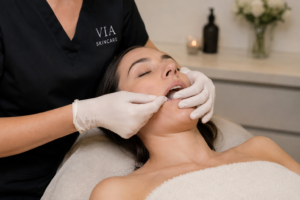
At Via Skincare, our Reconstructive Facelift Massage is designed around this principle. Each session works with the myofascial layer to release chronic contractures, restore glide between tissue planes, and reactivate the muscular support that keeps the face lifted from within. Manual lymphatic drainage is integrated to clear the congestion that adds heaviness to the midface and lower jaw. And where jaw tension, TMJ dysfunction, or deep facial muscle holding are contributing to structural compression, intraoral buccal work addresses what external massage alone cannot reach.
Results build across a series of sessions — not because we’re adding anything to the face, but because we’re systematically releasing what’s been pulling it out of position. The architecture doesn’t need to be replaced. It needs to be restored.
As we covered in our post on why sagging skin is a structural problem, and in our piece on the difference between a face that’s aging and one that’s collapsed, the thread running through all of it is the same: the face responds to what happens beneath the skin far more than it responds to what’s applied on top of it.
A Different Question to Ask
Before adding to your face, it’s worth asking what’s actually holding it. Is it a deficit of material — or a failure of the system that should be keeping everything in place?
For many people, the answer changes what they need entirely.
At Via Skincare in Los Angeles, the Reconstructive Facelift Massage addresses facial structure at its root — working the muscle, fascia, and lymphatic layers that determine how a face holds itself together. Book a consultation to understand what your face actually needs.
For practitioners looking to learn facial sculpting massage that works at the structural level, we offer professional certification courses.